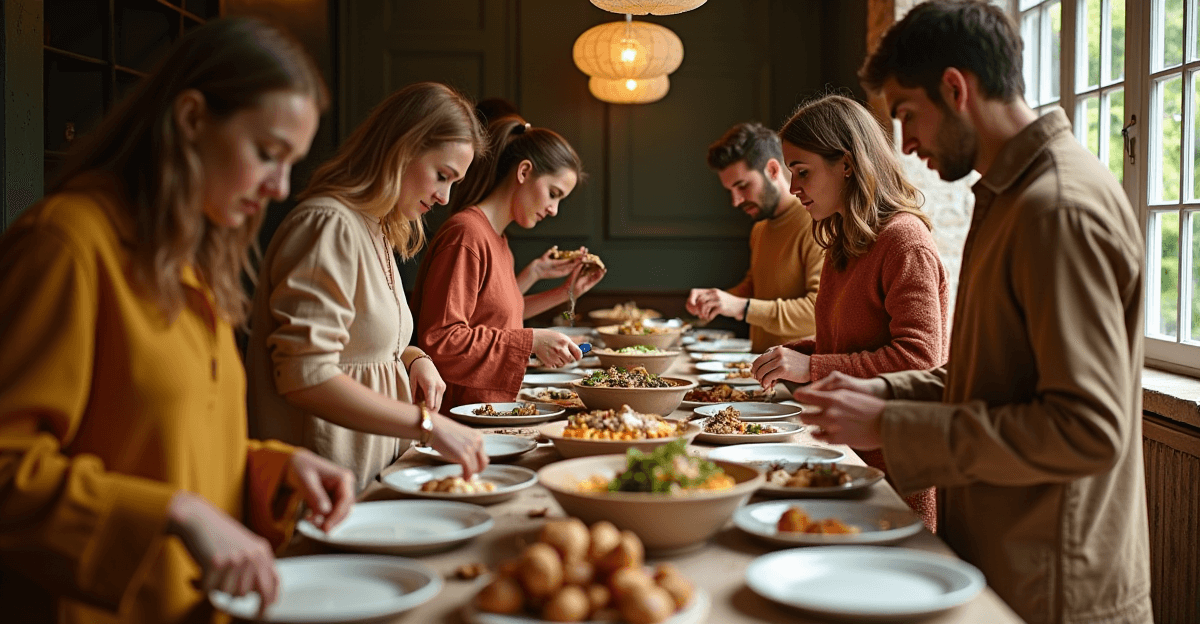
Eight Friends at the Buffet
One craving per word isn't enough. Multi-head attention sends eight specialized versions of every word to eight parallel buffets — and the whole upgrade is free, parameter for parameter, with one of the most beautiful tricks in the architecture.
Cat walks up to the buffet with one craving in its head.
Just one. The single-head attention move from the first Codex entry gives every word exactly that — one craving to score every label against, one plate to walk away with.
But hold the picture for a second. Cat, sitting in the middle of a sentence, simultaneously wants to know:
- Who's my verb? (sat)
- Where am I? (on the mat)
- Am I subject or object? (subject, here)
- What's describing me? (in another sentence: "the fluffy cat sat...")
That's four different things to hunt for in the rest of the sentence. With only one craving to express all four, cat has to average them into a single gray compromise — "something verb-ish and locational and adjectival and role-ish, please" — softmax that against every label, and walk away with a plate that's vaguely useful for everything and sharply useful for nothing.
Coming in cold? Self-attention is the move where every word in a sentence builds a new version of itself by taking a weighted mix of every other word, with weights set by how well its craving (Q) matches every other word's label (K), then mixing in their food (V). If that doesn't ring a bell, start here — this entry assumes you've got that picture in your head, plus the seat ribbons that bake position into every word.
That averaging-into-mush problem is what multi-head attention fixes. And the fix is one of the most elegant tricks in the whole architecture.
Eight buffet lines, side by side
Same potluck. Same sentence sitting at the table. But now there isn't one buffet — there are eight buffet lines running in parallel, side by side.
Each word sends eight specialized versions of itself to the eight lines:
- Line 1: cat's verb-finding craving — looking for action words.
- Line 2: cat's location-finding craving — looking for "on the mat."
- Line 3: cat's subject/object craving — looking for grammatical role cues.
- Line 4: cat's adjective-finding craving — looking for words that describe me.
- … and four more, each its own specialty.
Labels are also eight versions per word. Mat advertises itself one way in Line 1 (where verbs and objects are the topic) and a completely different way in Line 4 (where adjectives matter). Foods, the same — eight foods per word, one per line.
Each line runs a complete potluck at its own specialty. Eight cravings score eight sets of labels, eight softmaxes turn into eight sets of proportions, and out of each line walks a small plate. Eight mini-plates per word, side by side on a tray.
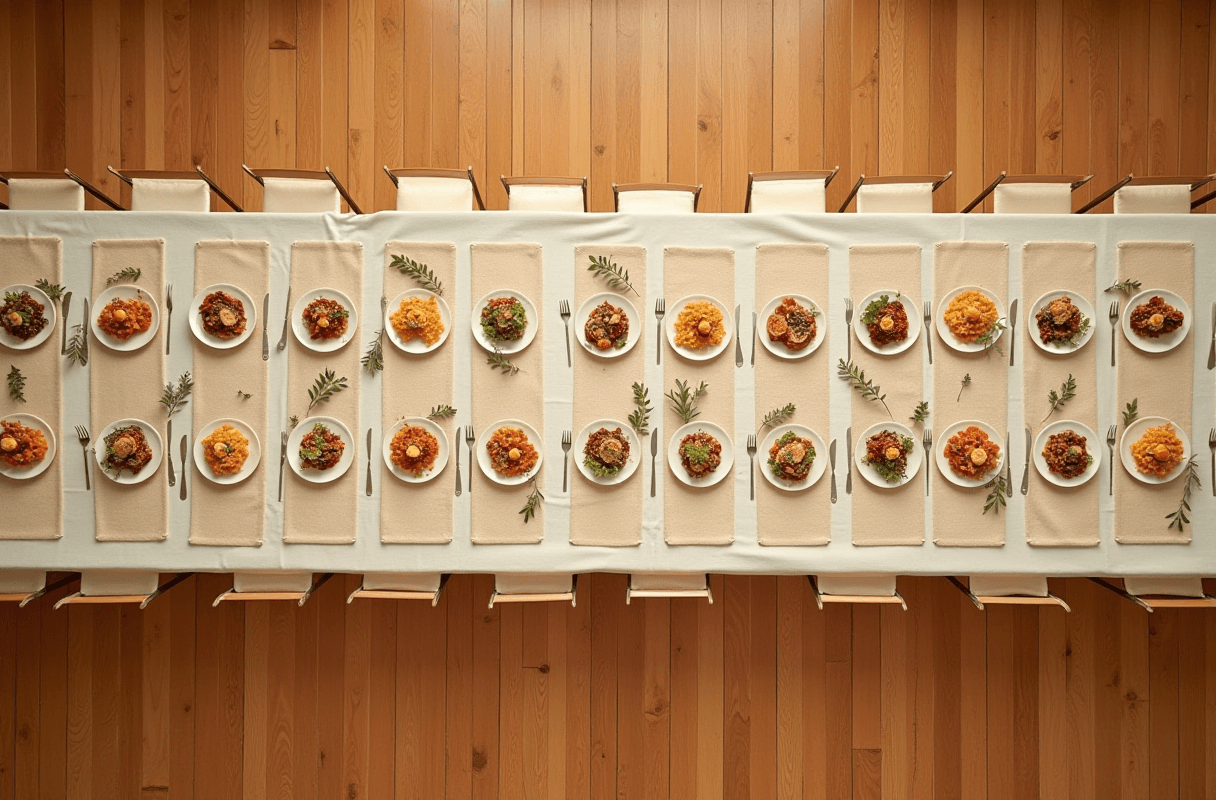
That's the whole picture. One tray, eight plates, one word.
Where specialization comes from
Here's the part that surprised me when I first sat with it: nobody designs which line does what.
There's no engineer writing "Line 1 = verbs, Line 2 = location, Line 3 = grammar." The eight lines all start identical, randomly initialized, indistinguishable. Specialization emerges during training because specialists produce sharper plates than generalists, and sharper plates lead to better predictions, and gradient descent rewards whatever produced the better prediction.
After enough training, the lines have drifted apart. Interpretability research on real models confirms it: some heads track grammar (subject→verb agreement), some track adjacent-word position, some latch onto rare words, some are induction heads that find "what came after this same token last time" and predict that next. (Most of what feels like in-context learning during inference traces back to induction heads, which is wild on its own.)
The specialization wasn't engineered. The architecture made room for eight independent opinions and training filled them in.
Twenty-four chefs at the entrance
Walk back through how a single word gets its Q, K, V. In the single-head world, three chefs at the entrance — Chef Q, Chef K, Chef V — each with their own learned recipe, translate the word into a craving, a label, and a food.
Multi-head changes the staffing.
Eight specialized buffet lines means twenty-four chefs at the entrance, not three.
Eight Chef-Q's. Eight Chef-K's. Eight Chef-V's. Each set drifts into its own specialty during training. Chef-Q-Line-1 learns to write verb-shaped cravings. Chef-Q-Line-2 learns location-shaped cravings. And so on for K's and V's. The entrance to the potluck is a much bigger kitchen than it was.
When cat arrives, all twenty-four chefs work on it in parallel. Cat gets converted into eight different cravings, eight different labels, eight different foods — one set per line. Then it splits and walks into all eight lines at once.
The Master Chef pulls the tray together
Eight mini-plates per word is progress, not the answer.
The next layer of the model — the next room in the hallway, in the language we'll get to in the next entry — doesn't want a tray of eight segregated plates. It wants one cohesive plate to work from. If you handed it the unblended tray, it'd see eight rigid silos: jalapeños in one corner, chocolate cake in another, kale somewhere else, none of them aware of each other.
The fix is the Master Chef, formally called the output projection .
The Master Chef takes the tray of eight mini-plates and blends them into one final plate. Not by averaging — by learning how to mix them. Some of Line 1's verb-finding output gets poured into the part of the final plate that informs grammar. Some of Line 3's location-finding output gets routed wherever spatial reasoning lives. The Master Chef's recipe is also learned during training — it's a single matrix, , that says here's how to combine eight specialist opinions into one integrated answer.
Without the Master Chef, multi-head is broken — the next room sees silos, not understanding. With it, the next room sees a unified plate that secretly carries all eight specialist signatures inside it.
The free lunch — and yes it really is free
Here's the part most people I've talked to don't quite believe the first time they see it.
Eight parallel buffets cost the same as one big buffet. Identical parameter count. Same training cost. Same inference cost.
When I first read this in 2017's Attention Is All You Need, I had to grab a piece of paper. Let me put the math right next to it because the table is the whole "aha":
| Single head, | 8 heads × | |
|---|---|---|
| 512 × 512 = 262,144 | 8 × (512 × 64) = 262,144 | |
| 262,144 | 262,144 | |
| 262,144 | 262,144 | |
| 262,144 | 262,144 | |
| Total | 1,048,576 | 1,048,576 |
Read that bottom row twice. One million and forty-eight thousand parameters either way. The eight-headed setup uses the same total parameter budget as the single-headed one — it just slices the budget into eight smaller, specialized chunks.
The trick: each of the eight lines works in a smaller flavor-space. Not 512 dimensions, but 64. Eight × 64 = 512. Same total chef-work distributed across eight specialists instead of concentrated in one generalist. The chefs are smaller, but you have eight times as many of them, and the totals match exactly.
You went from one averaged opinion to eight independent specialist opinions, for free.
How the math actually runs in production
The 2017 paper presented multi-head as eight separate small projections — eight (512 × 64) matrices for Q, eight more for K, eight more for V. Mathematically clean. Physically a bit silly: doing eight small matrix multiplications when GPUs are happiest with one big one is leaving performance on the floor.
Every modern implementation — PyTorch's nn.MultiheadAttention, every production LLM you've used — does this instead:
- One fat matrix per role. A single 512 × 512 instead of eight 512 × 64s. Same for and . (Multiply 8 × 512 × 64 — yes, that's 512 × 512.)
- One projection. Multiply the input by once. Same for K and V. Three big matmuls total.
- Reshape, don't re-project. Take the resulting matrix and split it into eight chunks of 64 dimensions each. No new computation — the same numbers, just viewed as eight side-by-side strips.
- Run attention per chunk. Eight parallel softmaxes, eight independent buffets, no interaction across chunks at this stage.
- Concatenate and project through . Stack the eight 64-dim outputs back into a 512-dim row and pass through the Master Chef.
Mathematically identical to the paper's formulation. Computationally, it's three big matmuls instead of twenty-four small ones. GPUs love this.
The shapes, end to end
If you find shapes more reassuring than analogies — I do, by reflex — here's what every tensor looks like for a sequence of tokens, , heads:
X:              10 × 512       input tokens (with seat ribbons baked in)
Q, K, V:        10 × 512       after one big projection per role
Q_i, K_i, V_i:  10 × 64        per head, after the reshape — 8 of these
Q_i K_iᵀ:       10 × 10        attention scores, per head
softmax:        10 × 10        per head
head_i out:     10 × 64        softmax @ V_i, per head
concat:         10 × 512       8 plates laid on the tray
final:          10 × 512       after W^O — the Master Chef's plate
The output rejoins the same dimensionality as the input, , ready to flow into the next room of the hallway. Multi-head doesn't change the shape of the river. It changes what's dissolved in it.
The whiteboard sentence
If I could hand you one sentence to pin up:
Multi-head attention runs the potluck eight times in parallel, with eight specialist cravings per word, and blends the eight resulting mini-plates into one integrated plate — for the same total parameter count as a single generalist head.
Eight friends at the buffet, each hunting something different, all coming back to compare notes through the Master Chef.
One craving averages. Eight cravings disambiguate.
What's next
The Codex is a living notebook, and the next entry pulls back to ask: now that one block does all this beautiful work, why do real models have forty-eight of them? That's "The Express Lane" — stacking transformer blocks, residual connections, and the question that bothered me until someone drew it out: when a word leaves Block 1 and walks into Block 2, what exactly does Block 2 see? (Spoiler: nothing is inherited. Every block grows its own chefs from scratch. The hierarchy that emerges across forty-eight blocks isn't designed — it falls out of statistics.)
After that, RoPE gets its own dedicated entry — the rotation trick that lets modern models read 256K-token documents from 8K-token training.
If any part of this one was unclear — if the Master Chef felt hand-wavy, if the parameter table didn't quite click on first read — tell me. The Codex is supposed to stick three weeks later, not just feel clever today.